Poinsettia Flower Red Floral Sublimation
First Impressions: A Bold, Festive Shape That Feels Hand-Drawn—Not Clipart
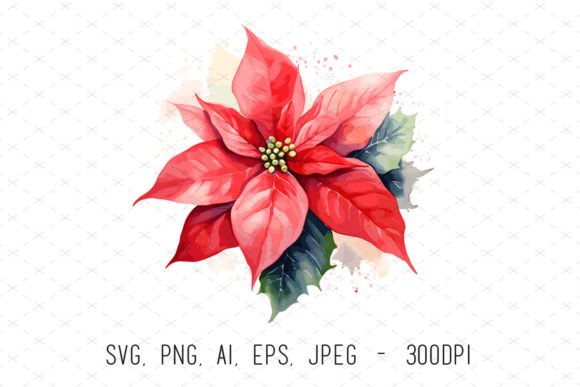
When I opened Poinsettia Flower Red Floral Sublimation, my first thought wasn’t “holiday cliché”—it was “this has presence.” The central bloom is generous but not overwhelming, with layered petals that suggest depth without relying on photorealism. There’s a gentle asymmetry in the outer leaves, and the stem curls just enough to feel organic—not stiff or vector-perfect. As an embroidery designer who’s stitched hundreds of floral motifs, I appreciate how this illustration leans into stylized elegance rather than botanical precision. It reads as warm, inviting, and quietly confident—ideal for handmade products where charm matters more than clinical accuracy.
Real Project Test: Embroidering It on a Linen-Cotton Kitchen Towel
Last week, I used Poinsettia Flower Red Floral Sublimation for a small-batch holiday kitchen towel line for a local boutique. We chose natural linen-cotton blend towels—textured, absorbent, and prone to puckering if stitch density isn’t balanced. I digitized the design (or adapted the provided embroidery file) with moderate fill stitch density and added subtle satin stitch edging on the largest petals. The result? Crisp definition without stiffness, and the red thread popped beautifully against the cream fabric. Customers commented on how “lively” and “crafted” it felt—not mass-produced. That’s the quiet power of this graphic: it translates well from screen to stitch because its shapes are bold enough to hold up at 3–4 inches wide, yet detailed enough to reward closer looking.
Where It Shines—and Where to Pause
Poinsettia Flower Red Floral Sublimation excels in projects where warmth and seasonal intention matter:
- Custom apparel: Works beautifully on crewneck sweatshirts (left chest placement), relaxed-fit tees, and even lightweight denim jackets—especially when paired with tonal red thread and light tear-away stabilizer.
- Baby and nursery items: Stitched on organic cotton burp cloths or muslin pillow covers, it reads soft and celebratory—not loud or commercial.
- Holiday gifts and boutique merchandise: Perfect for embroidered patches sewn onto wool caps, velvet pouches, or canvas tote bags meant for gifting. Its scale adapts easily between 2.5" and 4.5" without losing clarity.
- Digital product sellers: As an Illustrations asset, it layers cleanly over mockups—great for Etsy sellers previewing embroidered tea towels or printable gift tags.
But here’s where attention matters:
- Avoid dense fill areas on thin or highly stretchy fabrics (like ribbed knit baby onesies) unless you reduce stitch count or add cutaway stabilizer underneath.
- On dark fabric, test thread contrast first—some reds dull on charcoal or navy unless you use high-sheen polyester thread.
- Curved surfaces (like structured caps) require careful hooping and possibly slight simplification of petal tips to prevent distortion.
- If using it for an applique design, leave breathing room around the outer leaf edges—the original layout doesn’t include built-in seam allowances.
What It Adds to Your Finished Product—Beyond Just Looks
This isn’t just decoration. When stitched thoughtfully, Poinsettia Flower Red Floral Sublimation lifts perceived value. On a plain cotton apron? It transforms utilitarian into heirloom-feeling. On a personalized baby blanket? It signals care—not just speed. For Etsy sellers, that difference shows up in photos, reviews (“so much more elegant than other poinsettias I’ve seen”), and repeat buyers. It also supports brand consistency: whether you’re selling embroidered patches or digital embroidery files, this motif carries a cohesive, hand-hewn aesthetic that feels intentional—not algorithmically generated.
Practical Designer Notes Before You Stitch
Before committing to a full run—or listing your first machine embroidery design bundle—here’s what I do every time:
- Test on scrap fabric matching your final product’s weight and texture.
- Check thread color contrast in both natural and artificial light—red can shift dramatically.
- Review stitch density: look for areas where fill stitches might cause stiffness (especially near the stem base).
- Confirm hoop size compatibility—some versions may need repositioning for standard 4x4 hoops.
- Inspect small details: are petal tips sharp enough to read after stitching, or do they blur? Zoom in on the digital embroidery file before digitizing.
- Run a black-and-white mockup: helps spot unintended visual weight imbalances.
- Use proper stabilizer—lightweight cutaway for knits, tear-away for stable wovens like linen or duck canvas.
- Verify licensing: since this is categorized under Graphics, confirm whether commercial use (e.g., selling finished embroidered totes) is permitted, and whether resale of the digital embroidery file itself is allowed.
Final Thought: A Design That Earns Its Place
Poinsettia Flower Red Floral Sublimation doesn’t shout. It settles in—confidently, gracefully—wherever you place it. It’s the kind of motif that makes customers pause mid-scroll, that makes craft fair shoppers linger at your booth, and that gives your small shop product a quiet signature. It’s not “just another floral.” It’s a considered choice—for designers who care how something feels to wear, hold, give, or live with. And in a market flooded with generic holiday graphics, that kind of intentionality is the most valuable thread of all.