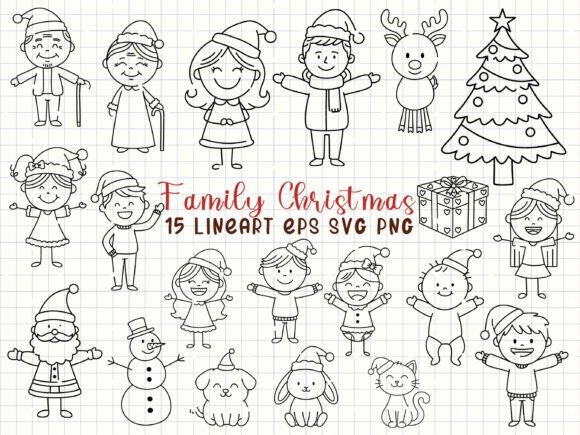
Family Christmas Line Art Holiday SVG
A Doodle-Soft Touch for Handmade Holiday Charm
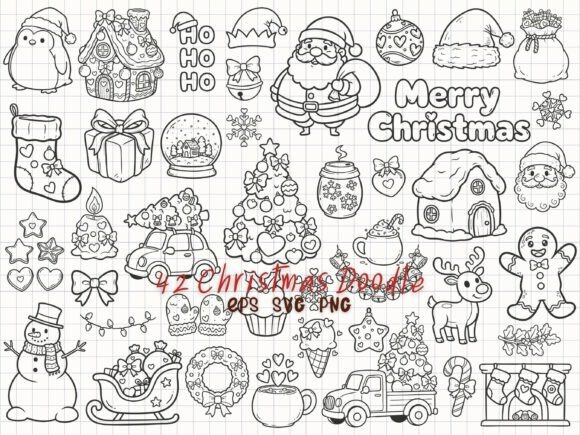
First impression? This Family Christmas Line Art Holiday SVG feels like flipping open a well-loved sketchbook—light, warm, and full of quiet intention. It’s not bold or flashy; it’s the kind of design that invites closeness. Fifteen doodle-style illustrations—family members holding hands, Santa with a gentle smile, a child peeking from behind a tree—all drawn with confident, uneven lines and subtle weight shifts. There’s no heavy fill, no dense shading—just clean, rhythmic outlines that breathe. That simplicity is its strength—and its first real test in embroidery.
What It Becomes When Stitched: A Real Project Moment
Last week, I prepped a custom embroidered tote bag for a local boutique: natural canvas, medium-weight, slightly textured. I chose one of the smaller family group motifs from the Family Christmas Line Art Holiday SVG set—not the largest Santa, but the three-generation silhouette holding ornaments. Why? Because line art translates best when scale and fabric work together. On that tote, the running-stitch interpretation (converted manually to a low-density machine embroidery design) kept the sketchy charm intact—soft edges, visible thread texture, no stiffness. Customers paused at the counter. Not because it shouted “Christmas!” but because it whispered “handmade care.” That’s the quiet power of this set: it supports storytelling, not just seasonal decoration.
Where It Shines—and Where It Needs Thought
The Family Christmas Line Art Holiday SVG thrives in projects where personality matters more than precision:
- Personalized gifts: Embroidered baby onesies, tea towels for new parents, or pillow covers for grandparents—its gentle scale and open lines avoid overwhelming small surfaces.
- Small shop merchandise: As an embroidered patch on denim jackets or aprons, it reads clearly without needing heavy stabilizer or dense fill stitch.
- Holiday apparel: On crewneck sweatshirts or relaxed-fit tees, the line weight holds up well—even at 3.5–4 inches wide—without bleeding into fabric texture.
- Digital product previews: As Illustrations, these convert cleanly to printable mockups or social media banners—no pixelation, no awkward anti-aliasing.
Where to Pause Before Pressing “Embroider”
This isn’t a plug-and-stitch file for every surface. Its delicate line quality demands attention to context:
- Small hoop sizes (under 4"): Some motifs include fine interior details—like mittens or tiny bows—that may vanish or distort unless digitized with intentional stitch spacing. Always inspect corners and narrow loops before finalizing.
- Textured or stretchy fabrics: Linen, slub cotton, or lightweight knits can swallow thin lines. Use tear-away + cutaway stabilizer combo, and consider widening line weight slightly in your embroidery software.
- Dark or dense backgrounds: The original line art assumes contrast. On navy twill or charcoal fleece, test thread colors carefully—cream or heather gray often reads warmer and clearer than stark white.
- Curved surfaces (caps, mugs, curved pillow seams): Avoid motifs with tight clusters of intersecting lines—they’ll shift or pucker. Stick to single-figure silhouettes or spaced groupings.
- Frequent-wash items (baby clothes, kitchen towels): Running stitch alone won’t hold up long-term. Reinforce key outlines with a second pass or add minimal satin stitch caps on hands/feet for durability.
Why It Builds Trust—Not Just Decoration
When you use the Family Christmas Line Art Holiday SVG in a finished product, you’re not just adding holiday flair—you’re signaling intentionality. Buyers notice when a design doesn’t fight the fabric, when stitches flow instead of fighting, when a personalized gift feels *seen*, not stamped. That soft, hand-drawn rhythm tells customers: “This wasn’t auto-generated. Someone chose this shape, paced this line, considered how it would live on your sweater or your child’s blanket.” For Etsy sellers and craft fair vendors, that perception lifts perceived value—no price hike needed.
Practical Designer Notes You’ll Actually Use
Before stitching your first piece:
- Test on scrap fabric first—especially if using textured weaves or blends. Watch how thread settles into the grain.
- Check thread color contrast on both light and dark swatches. Doodle lines need clarity, not camouflage.
- Review stitch density in your embroidery software. If converting from SVG, avoid over-digitizing—let the line speak for itself.
- Confirm hoop size vs. motif width. Some figures span nearly 5", so plan layout early for multi-item projects like quilt blocks or matching sets.
- Inspect small details at 200% zoom: are eyes, buttons, or ornament loops legible as stitch paths—or do they collapse?
- Try black-and-white mockups before committing to color palettes. Line art lives or dies by contrast.
- Verify licensing before selling finished items or bundling as part of a digital embroidery file pack. Since this is listed as Graphics, confirm commercial use rights directly with the creator.
Final Thought: Less Is Warmly Remembered
The Family Christmas Line Art Holiday SVG won’t dominate a room—but it might linger in memory longer than a glitter-heavy alternative. It’s the kind of design that works hardest when it looks effortless: on a linen apron worn while baking cookies, stitched onto a child’s first holiday stocking, or quietly anchoring a boutique’s holiday collection. It asks for thoughtful placement, not loud execution. And for embroidery designers, small shop owners, and makers who build meaning into every stitch—that’s not a limitation. It’s an invitation.