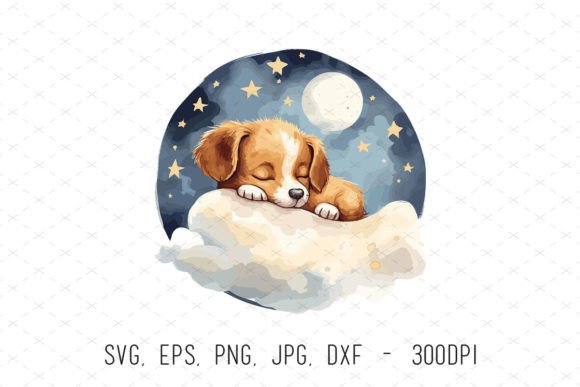
Watercolor Nursery Sleeping Dog Clipart
A Soft, Dreamy Vibe—But Will It Stitch Cleanly?
First impression? This Watercolor Nursery Sleeping Dog Clipart lands with quiet charm—gentle washes of color, blurred edges, and a curled-up puppy radiating calm. It’s undeniably sweet, tender, and nursery-ready. As an embroidery designer who’s stitched hundreds of animal motifs—from bold cartoon pups to hyper-realistic terriers—I immediately scanned for what matters most in real-world use: shape clarity, edge definition, and stitch-friendly simplicity. Unlike sharp vector icons or high-contrast silhouettes, this design leans into painterly softness. That’s lovely on paper or screen—but embroidery doesn’t “paint.” It builds form with thread, one stitch at a time. So my first question wasn’t “Is it cute?” (it is). It was “Where will those watercolor edges translate—and where might they blur into mush under needle and thread?”
Real Project Test: A Custom Embroidered Baby Pillow Cover
Last week, I prepped a small-batch order of organic cotton pillow covers for a local boutique—each personalized with a baby’s name and a sleeping animal motif. I pulled up the Watercolor Nursery Sleeping Dog Clipart as a candidate. On screen, it looked perfect: cozy, gender-neutral, gentle. But when I opened it in my embroidery software and zoomed in, I noticed how much of the “watercolor” effect relies on subtle gradients and feathered transparency—elements that don’t convert cleanly to satin or fill stitch without careful reinterpretation. The sleeping pose is compact and centered—ideal for a 4" hoop—but the floppy ears and blended paws lack crisp internal lines. That means if stitched as-is on low-density fabric like cotton twill or linen, those soft edges could bleed or lose definition. Not a dealbreaker—but a signal to adjust, not assume.
Where It Shines (and Where It Needs Care)
- Best for: Sweatshirt embroidery (medium-weight fleece), tote bag design (canvas or duck cloth), nursery decor (wall hangings, framed hoops), tea towels, and baby blankets—fabrics that support gentle stitch density and benefit from a soothing, unhurried aesthetic.
- Use carefully on: Stretchy knits (like onesies), dark fabric (where light watercolor tones vanish unless adjusted), curved surfaces (caps/hats—soft edges won’t anchor well), and tiny hoop sizes (<3"). Also avoid dense layering—this isn’t an applique design; it doesn’t have built-in backing or clean cutlines.
- Not ideal for: High-detail patches, commercial embroidery requiring crisp scalability, or products meant for frequent washing without gentle care—the delicate tonal shifts may soften over time if thread contrast isn’t intentional.
What It Adds to Your Handmade Product—And What It Asks of You
The Watercolor Nursery Sleeping Dog Clipart elevates perceived value—not through flash, but through emotional resonance. Customers browsing Etsy for baby gifts respond strongly to warmth and authenticity. This design feels handmade *before* it’s even stitched. That helps small shop owners and craft fair sellers stand out next to mass-produced graphics. But that softness comes with responsibility: you’ll need to guide the stitch execution. For example, choosing thread colors with enough contrast (e.g., charcoal gray instead of pale taupe on ivory fabric) preserves legibility. Using medium-weight tear-away stabilizer—not just basic cutaway—keeps the watercolor flow intact without stiffness. And yes, always test on scrap fabric first: run a sample on your exact garment type, check how the fill stitch settles into the weave, and verify that the sleeping dog reads clearly at 5–6 inches wide—the sweet spot for most nursery items.
Practical Designer Notes Before You Stitch
- Review stitch density: If the original file uses ultra-fine gradient fills, simplify to broader satin or gentle fill stitch zones—embroidery machines can’t replicate pixel-level watercolor diffusion.
- Confirm hoop size compatibility: Its compact layout fits standard 4"x4" hoops, but double-check whether corners or subtle highlights extend beyond safe stitching margins.
- Test black-and-white mockups: Does the silhouette hold up without color? If the shape disappears in grayscale, it’ll struggle on dark or textured fabric.
- Compare light vs. dark backgrounds: Watercolor tones often rely on underlying white for luminosity—on navy or charcoal fabric, you may need to add a subtle white underlay or adjust saturation manually.
- Verify licensing: Since the product description states it’s usable for “t-shirts, greeting cards, gifts, website designs, paper crafts and much more,” confirm whether commercial resale of finished embroidered items is explicitly permitted—especially for Etsy sellers and digital product creators.
Final Thought: A Design That Invites Intention
The Watercolor Nursery Sleeping Dog Clipart isn’t a plug-and-play machine embroidery design. It’s a starting point—a mood, a feeling, a quiet moment made visual. That makes it powerful for creative entrepreneurs who understand that the best handmade products aren’t just stitched—they’re thoughtfully interpreted. It works beautifully when paired with thoughtful thread selection, appropriate stabilizer, and realistic expectations about fabric behavior. Use it for custom apparel that soothes rather than shouts, for nursery decor that breathes, for personalized gifts that feel like a whisper instead of a headline. Just remember: watercolor on screen isn’t the same as watercolor in thread. Let the clipart inspire—but let your embroidery judgment lead.