Soft Vintage Strawberry Clipart Set
A Designer’s First Look: Charm Without Clutter
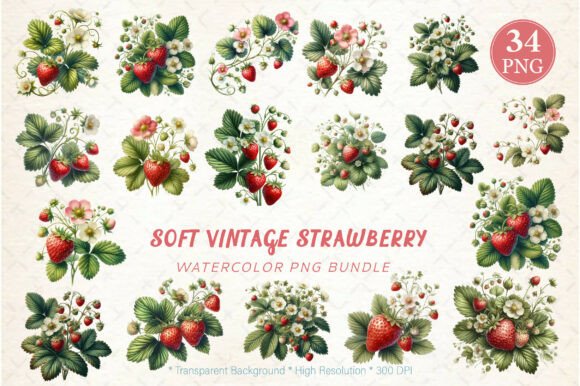
Opening the Soft Vintage Strawberry Clipart Set, I immediately felt that quiet, sunlit nostalgia—like flipping through a well-loved 1970s recipe book or spotting faded strawberry motifs on a linen tea towel at a country antique shop. These aren’t hyper-detailed botanicals or cartoonish icons; they’re gentle, intentional, and quietly confident. With 34 designs in solid color and distressed effect styles, each one breathes space—no frantic linework, no over-rendered shadows. That matters deeply when translating to stitch. I pictured them instantly on a natural cotton tote bag for a local farmers’ market vendor: soft enough for moms and grandmas alike, distinctive enough to stand out among generic florals.
How It Stitches: From Screen to Seam
I tested two designs—one solid, one distressed—on midweight cotton twill (for an apron) and lightweight jersey (for a baby onesie). The clean outlines held up beautifully in satin stitch, especially the leafy stems and rounded berry shapes. No jagged edges, no pixelation—even zoomed in at 300 DPI, the 3600 × 3600 px resolution gave me room to resize down to 3″ without losing integrity. That’s rare in clipart meant for embroidery use.
The distressed versions? They translate surprisingly well—not as literal texture in thread, but as intentional visual rhythm. When stitched with matte cotton thread on unbleached canvas, the subtle graininess reads as hand-drawn warmth, not digital artifact. That makes them ideal for boutique-branded kitchen towels, nursery pillows, or holiday gift sets where “handmade feel” is part of the value proposition.
Where It Shines—and Where to Pause
This set excels in projects where subtlety supports story: embroidered sweatshirt cuffs, patch-backed denim jackets, baby embroidery on organic cotton bibs, or delicate applique designs on linen pillow covers. It’s also strong for commercial embroidery—think small shop merchandise like branded tea towels for a local jam company or custom tote bags for a garden center.
But be thoughtful with placement. On highly textured fabrics like terry cloth or bouclé, the finer distressed details can blur. On stretchy knits (especially for toddler tees), I recommend testing stabilizer layers first—light tear-away works, but medium cut-away gives cleaner definition around curved berry contours. And avoid placing the smallest designs—like the single stemmed strawberry—on dark fabric without checking thread contrast in a printable mockup first. What looks balanced on screen may vanish under navy or charcoal without a subtle outline stitch or backing layer.
Real-World Fit: A Holiday Apron Project
Last week, I prepped a holiday-themed apron line for a craft fair client. We chose three designs from the Soft Vintage Strawberry Clipart Set: a full cluster, a single berry with vine, and a tiny strawberry tucked into a corner motif. Stitched at 4.5″ wide on oat-colored linen, they read clearly at arm’s length but soften beautifully up close—no harsh lines, no visual shouting. Customers didn’t just say “cute”; they said “I can picture my grandma wearing this.” That emotional resonance? That’s what turns a machine embroidery design into a finished product people want to hold, gift, and keep.
Design Assets That Support Your Brand—Not Distract From It
As someone who reviews hundreds of digital embroidery files yearly, I notice how often “cute” designs undermine professionalism. Not here. The Soft Vintage Strawberry Clipart Set has consistent stroke weight, balanced negative space, and a cohesive palette that plays well with both earthy and pastel thread colors. That means your Etsy listings stay on-brand whether you’re selling embroidered patches or printable mockups for other designers. It also means less time tweaking—no need to simplify outlines or rebuild corners. What you see is what stitches.
For craft business owners, that consistency builds trust. A customer ordering a personalized gift expects charm *and* clarity. This set delivers both: the strawberry shape remains legible even at 2.75″, and the distressed variants add character—not confusion.
Practical Notes Every Embroidery Designer Should Check
- Always test on scrap fabric first—especially for the distressed versions, which behave differently on cotton vs. poly blends.
- Review stitch density before scaling up. While these are clean vector-derived PNGs, your embroidery software will interpret detail differently than a graphic designer would.
- Confirm hoop size compatibility. At full 12″ scale, these are best suited for larger commercial hoops—but most designs scale gracefully down to fit standard 4×4 or 5×7 hoops.
- Inspect small details like seed dots and vine tips. Some may require slight manual cleanup in your embroidery editor if converting to stitch format.
- Test black-and-white mockups to gauge contrast on light and dark fabric backgrounds—critical for product photos and listing thumbnails.
- Use proper stabilizer: medium-weight cut-away for knits, light tear-away for stable wovens.
- Verify licensing before selling finished items or bundling as design assets—this set is delivered as PNGs, so conversion to embroidery file requires your own digitizing or a trusted service.
Final Thought: Not Just Clipart—A Quiet Design Ally
The Soft Vintage Strawberry Clipart Set doesn’t demand attention. It earns it—through restraint, rhythm, and real-world adaptability. It fits seamlessly into handmade product lines, supports small shop branding without overwhelming it, and adds warmth to personalized gifts without sacrificing polish. For embroidery designers, Etsy sellers, and creative entrepreneurs who value authenticity over algorithm-chasing, this isn’t just another graphics download. It’s a reliable, mood-aligned tool—one that helps your next embroidered patch, sweatshirt, or holiday kitchen towel feel thoughtfully made, not mass-produced.