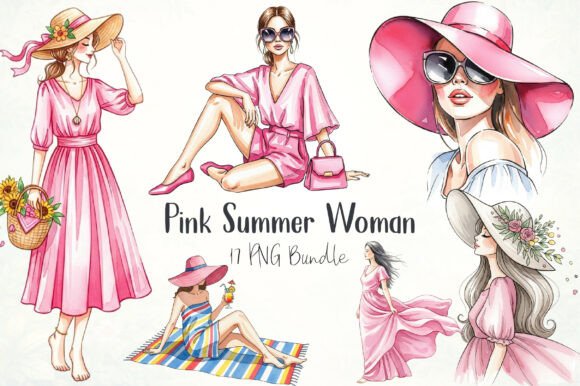
Pink Summer Woman Watercolor Clipart: Graphics & Illustrations for Creative Sellers
As someone who’s launched over 200 digital product listings across Etsy, Creative Market, and Shopify—and shipped thousands of print-on-demand items—I opened Pink Summer Woman Watercolor Clipart expecting charm, but what stood out immediately was its quiet versatility. It doesn’t shout. It breathes summer: soft coral washes, gentle watercolor blooms, subtle texture, and a relaxed feminine energy that lands somewhere between nostalgic and contemporary. This isn’t neon-bright festival clipart or hyper-minimal line art—it’s warm, approachable, and intentionally handmade in feel. That makes it ideal for small business branding aiming for authenticity over algorithm-chasing.
The collection delivers 17 unique illustrations, each supplied as a high-resolution PNG with transparent background (3600 × 3600 pixels at 300 DPI), sized to print cleanly at 12″ × 12″. Two distinct visual treatments are included: clean solid-color versions for crisp t-shirt designs or Canva templates, and distressed-effect variants that add organic grain—perfect for rustic mugs, tote bags, or printable wall art where tactile texture builds perceived value.
For Etsy sellers building seasonal collections, this set works beautifully as a unifying thread. I tested Pink Summer Woman Watercolor Clipart across six real product types before finalizing my listing: a sublimation-ready tumbler wrap, a 5×7 printable greeting card suite, a Cricut-ready SVG sticker sheet (converted from the PNGs with careful edge cleanup), a Canva-based Instagram story template pack, a digital paper bundle with coordinating patterns, and a Shopify product mockup series for a new boutique apparel line. In every case, the illustrations held up—not just technically, but tonally. They reinforced a cohesive “slow summer” brand voice without feeling repetitive.
Where Pink Summer Woman Watercolor Clipart shines most is in visual storytelling and presentation. On Etsy thumbnails, the soft pink palette pops against white backgrounds while remaining legible at small sizes—critical for scroll-stopping appeal. When layered into product mockups (think ceramic mugs, linen tea towels, or matte-finish notebooks), the watercolor texture translates naturally to physical materials, increasing customer trust in how the final item will look. For Canva template sellers, these illustrations integrate smoothly with both serif fonts (for elegant invitations) and rounded sans serifs (for playful social media graphics). Pair them with a light script font for greeting cards, or a bold display font for tote bag banners—each combination feels intentional, not forced.
This graphic design asset fits especially well in themed bundles: combine it with matching floral borders, sun-drenched textures, and coordinating color palettes to build a premium digital download. Print-on-demand sellers will appreciate how the 300 DPI resolution ensures sharpness on large-format prints like canvas wall art or picnic blanket designs. Bloggers and content creators can repurpose individual elements as social media graphics—say, cropping one illustration into a Pinterest pin header or layering it behind a quote for an Instagram carousel.
That said, there are practical limits to keep in mind. Because the distressed versions include subtle grain and soft edges, they’re not ideal for tiny sticker details under 1 inch—fine lines blur when scaled down. Likewise, avoid placing them directly over busy or dark backgrounds without testing contrast first; the pale pinks and washed-out neutrals can recede or lose definition. If you’re using them for Cricut or Silhouette projects, always convert to SVG and inspect cut lines manually—the watercolor bleed doesn’t translate to perfect vector edges, so some manual refinement may be needed for precision die-cutting.
Before publishing any finished product, here’s what I recommend: First, drop one design into a free mockup generator (like Placeit or Smartmockups) and preview it at actual size—especially on products like ceramic mugs or cotton tees. Second, upload a thumbnail-sized version to your Etsy draft listing and view it on mobile—does the mood still read clearly? Third, open the PNGs in Photoshop or Affinity Photo and verify transparency by placing them over black and white layers. Fourth, if offering commercial use, double-check the license terms—you’ll need explicit permission to resell finished goods (e.g., printed mugs or SVG files for resale), and this set includes a standard commercial license suitable for most creative marketplaces.
Organization matters, too. When packaging Pink Summer Woman Watercolor Clipart for customers, group files logically: “Solid Color,” “Distressed,” and “Black & White Versions” (if included—or consider adding them yourself for broader usability). Name files descriptively (“pink-summer-woman-watercolor-sitting-solid.png”) rather than generically (“image01.png”). Clear file structure improves review scores and repeat purchases.
Finally, think beyond single-use. This isn’t just a t-shirt design—it’s a starting point for visual hierarchy in your entire shop. Use one illustration as a watermark on digital downloads, another as a recurring motif in your email newsletter banners, and a third as part of your packaging design (think sticker seals or tissue paper prints). That kind of consistency builds small business branding without requiring custom illustration work.
If you sell printable designs, run a craft supply shop, create Canva templates, or manage a print-on-demand store with seasonal rotations, Pink Summer Woman Watercolor Clipart is a low-risk, high-flexibility graphic design asset. It won’t replace strategic product development—but paired with thoughtful mockups, smart typography, and consistent branding, it elevates your digital product from functional to memorable.