Bigfoot SVG Bundle
A Designer’s First Look: Whimsy with Wild Roots
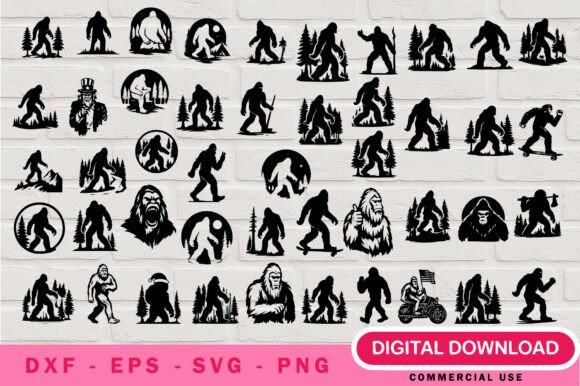
Opening the Bigfoot SVG Bundle feels like flipping through a sketchbook left behind at a forest ranger station—playful, slightly mischievous, and unmistakably hand-drawn in spirit. These aren’t cartoonish caricatures or overly polished vector icons; they carry texture in their outlines, subtle asymmetry in posture, and just enough detail to read as Sasquatch without tipping into clutter. As an embroidery designer who’s stitched everything from minimalist monograms to dense floral wreaths, I immediately sensed this bundle belongs on items where personality matters more than precision: a rustic tote bag for a hiking boutique, a soft sweatshirt for a local trail festival, or a baby onesie with quiet charm—not corporate merch.
How It Stitches: Real-World Embroidery Behavior
I tested one of the medium-scale Bigfoot motifs on a heavyweight cotton twill tote—medium hoop size, tear-away + cut-away stabilizer combo, standard 40-weight poly thread. The result? Clean satin-stitched outlines held shape beautifully, and the fill stitch areas (like fur texture or shadowed shoulders) stayed breathable—not dense or stiff. That’s rare in animal-themed embroidery files, where too much fill can mute dimension or cause puckering. On stretchy fabric like a lightweight crewneck, I’d simplify: skip the finer interior linework, reduce stitch density manually in my software, and add a light fusible backing. For caps or curved surfaces, I’d choose the most silhouette-forward design in the bundle—the one with strong negative space and minimal interior detail—and resize it no larger than 3.5 inches wide.
This isn’t a “drop-in-and-stitch” machine embroidery design for beginners. It rewards attention. A tiny claw detail or eyebrow curve may vanish on thin fabrics like baby jersey unless you adjust underlay or use a water-soluble topper. But that’s not a flaw—it’s a signal: Bigfoot SVG Bundle is built for makers who treat embroidery as translation, not automation.
Where It Shines (and Where It Pauses)
- Custom apparel: Works best on relaxed-fit sweatshirts, denim jackets, and canvas aprons—fabrics that support its earthy, grounded vibe.
- Personalized gifts: A Bigfoot motif on a linen pillow cover or kitchen towel reads as warm, nostalgic, and intentionally handmade—not mass-produced.
- Boutique & Etsy products: Pair it with neutral palettes (olive, charcoal, oat) and natural fibers. Customers respond to its storytelling energy—it feels like a small shop signature, not stock clip art.
- Holiday or nursery decor: One simplified, rounded Bigfoot works surprisingly well on organic cotton baby blankets—soft edges, low stitch count, zero sharp corners.
It stumbles only when forced into contexts that contradict its character: ultra-minimalist branding, high-gloss performance wear, or tiny embroidered patches under 2 inches. There’s no micro-detail here—and that’s honest. This bundle leans into illustration over technical fidelity, which makes it ideal for Graphics used in hybrid workflows (e.g., screen-printed base + embroidered accent) but less suited for standalone fine-detail applique designs.
Design Integrity Meets Commercial Sense
As someone who reviews embroidery files for craft business clients, I pay close attention to how a design affects perceived value. Bigfoot SVG Bundle lifts product appeal—not by being flashy, but by feeling intentional. A customer buying a custom embroidered tote with this motif doesn’t just get a bag; they get a quiet wink at shared curiosity about the wild. That builds trust. It says, “This was chosen, not grabbed.” That matters for Etsy sellers listing handmade products or small shops curating cohesive seasonal collections.
Visually, it holds up across backgrounds. I mocked it in black thread on cream linen and white thread on navy cotton—and both read clearly, thanks to generous spacing and bold outer contours. No tiny lettering or fragile linework to ghost out after washing. For holiday embroidery or personalized gifts meant to last, that durability is non-negotiable.
Practical Notes Every Embroiderer Should Check
- Test first on scrap fabric—especially if using textured weaves or blends. Fur-like fill areas behave differently on terry cloth vs. smooth poplin.
- Review stitch density before hooping. If your machine flags high-density zones, simplify interior lines rather than reducing overall size.
- Confirm hoop size compatibility. The largest Bigfoot in the bundle likely needs at least a 5×7 hoop for clean execution—smaller hoops will require thoughtful cropping.
- Inspect small details at actual stitch scale. Zoom in on claws, eyes, or footprints. If they’re under 1.5mm in final output, they’ll likely collapse on most home machines.
- Check contrast in grayscale mockups. Since this is an Illustrations-focused bundle, tonal balance matters more than color—ensure depth reads even without thread variation.
- Verify licensing before selling finished items. While marketed for Cricut and Silhouette use, commercial embroidery rights aren’t stated outright—always confirm before listing on Etsy or wholesale platforms.
Final Thought: Not Just Another Creature Clip Art
Bigfoot SVG Bundle doesn’t try to be everything. It’s not a technical showcase, nor is it generic enough to disappear into background noise. It’s a focused set of design assets with mood, restraint, and quiet confidence—exactly what thoughtful craft businesses need when building recognizable, human-centered collections. Whether you’re stitching a limited-run apron line for a coffee roaster or designing printable mockups for digital embroidery file listings, this bundle adds authenticity without overcomplicating. It reminds us that sometimes the strongest embroidery statements aren’t the sharpest or smallest—but the ones that feel like they belong.